
Blog Post
Data Classification Decoded: How AI Supports Actionable Information Governance

Managing Director,
FTI Consulting

Senior Director,
FTI Consulting

Managing Director,
FTI Consulting



With the ongoing and unprecedented growth in data volume, complexity and regulatory exposure, organizations are struggling to keep their information governance programs aligned and resourced. The challenges are compounded by rising expectations and requirements related to data privacy, security and responsible use of information. Legal and governance leaders knowing they must maintain good data hygiene across their organization and appropriately classify data across sources, but translating that into meaningful outcomes remains elusive for many. Artificial intelligence solutions are emerging to help bridge this gap by enabling effective, automated and defensible data classification.
At the AI+IM Global Summit 2026, FTI Technology experts explored how modern classification, powered by AI can help change the equation. A clear message resonated throughout the discussions: classification is no longer merely a function of labelling data; it’s needed for enabling action at scale.
Rethinking data classification
Data classification often means different things to different teams. Security teams focus on identifying sensitive and confidential data, while privacy teams focus on personal and regulated data. Separately, records management professionals want to inventory data for retention and disposal controls.
While all these perspectives are valid, they often result in fragmented approaches. For modern information environments, a more practical definition is required, with data classification seen as the process of understanding and organizing information based on what it contains, regardless of framework, system or location.
This definition brings together personal and sensitive data (e.g., personally identifiable information, personal health information, financial information), business content and record types (e.g., contracts, invoices, human resources records) and security classifications (e.g., public, confidential, legally privileged).
Why does this matter? Because governance, security, and compliance controls can only work effectively when driven by content intelligence, not assumptions about where data lives.
Classification is foundational
When organizations can reliably classify information, they unlock a wide range of operational and risk management benefits.
Effective classification supports:
- Regulatory compliance and auditability, including demonstrable data minimization.
- Defensible retention and deletion, reducing legal and regulatory exposure and storage costs.
- Faster, more proportional incident response, with immediate clarity on impacted data.
- Reduced e-discovery and investigation costs, through reduced data volumes.
- Proportionate security controls, aligned to data sensitivity and business value.
- Safer deployment of analytics and AI, with clear governance boundaries.
In practice, classification can shift from being an abstract checklist activity to a decision‑making engine that enables compliant actioning of data.
AI and context at scale
Traditional classification methods such as keywords, regular expressions and exact data matching remain useful. On their own, however, they are not as effective with scale, nuance and unstructured content.
AI can help to bridge that gap.
With proper design, implementation and expert oversight, modern machine learning models and large language models can help:
- Interpret content in context, not only pattern matching.
- Distinguish between similar documents with different intent or meaning.
- Handle inconsistent, real‑world information.
- Operate across millions of items with high accuracy.
Crucially, AI does not replace traditional classifiers, it augments them. The most effective classification programs combine multiple technologies, each aligned to a specific risk or business outcome.
Classification technology: One size does not fit all
AI‑driven approaches often deliver greater value faster than traditional approaches, and once scaled across enterprise environments, they can achieve improvements with reduced operational overhead.
Different classification approaches deliver value in different scenarios, such as:
- Keywords and RegEx remain effective for well‑structured identifiers.
- Exact data match works well for known datasets at scale.
- Machine‑learning classifiers recognise patterns in varied content.
- Natural language processing extracts entities and sentiment.
- Large language models provide deep contextual and semantic understanding.
Treat classification as a lifecycle
One of the most common causes of failure in upholding a sustainable data classification program is treating it as a one‑time technical implementation.
Successful organizations approach classification as a governed lifecycle that includes steps such as:
- Defining business objectives and required actions.
- Selecting and configuring appropriate classifiers.
- Testing for precision, recall and noise.
- Deploying in controlled phases.
- Continuously monitoring, refining and optimizing outputs.
This approach recognises that data, business processes, regulatory regimes, technological capabilities and risk profiles evolve, and classification must evolve with them.
From classification to action
Classification is only valuable if it drives outcomes. Once information is classified, it can drive action. For example, data is classified against the appropriate retention categories, retention and deletion can be actioned. Classification enables a range of information management capabilities, many of which are captured in this illustration.
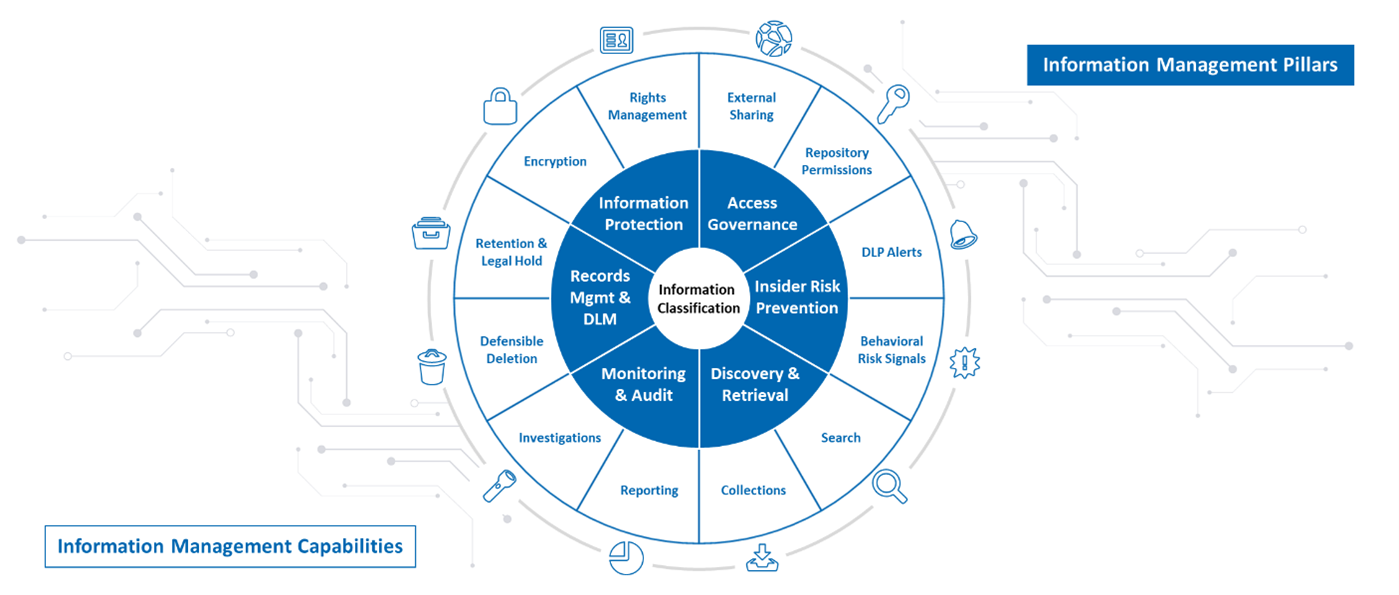
In effect, classification becomes the control plane connecting information management, security and compliance capabilities. Without it, organizations rely on manual workarounds and reactive responses.
Real world impacts
Practical examples shared at the Summit demonstrated this shift in action. Examples include:
- Scaling data loss prevention: A global pharmaceutical company used a combination of built‑in and custom classifiers to rapidly deploy Microsoft Purview DLP controls focused on the organization’s five most important information assets (e.g., intellectual property, sensitive data) with minimal user disruption. Iterative tuning and reduced noise improved detection and enabled early identification of serious data loss incidents. Security for Copilot (AI) is being considered to support the triage of alert events for further automation.
- Generative AI for complex documents: In a high‑pressure litigation scenario, an AI‑powered classification workflow analyzed thousands of documents, assigning issue categories and severity with transparent reasoning. The result was faster insight, defensible prioritization and a significant reduction in manual review effort, all under extreme time constraints.
These examples highlight that AI can support classification at a level of speed, nuance and defensibility that was previously unattainable.
Information governance experts generally agree that classification is the foundation of effective information management. Now, AI has transformed what is achievable, when applied in a pragmatic and controlled manner that links classification directly to business action.
When implemented well, an AI-driven approach to classification can reduce risk, lower costs and remove friction, while empowering organizations to innovate with confidence.
To explore how AI‑driven classification can support information governance, security or compliance, FTI Technology experts works with organizations globally to design and deliver defensible, scalable solutions.
Related topics:
The views expressed herein are those of the author(s) and not necessarily the views of FTI Consulting, its management, its subsidiaries, its affiliates, or its other professionals.